Speaker A [00:00:01]:
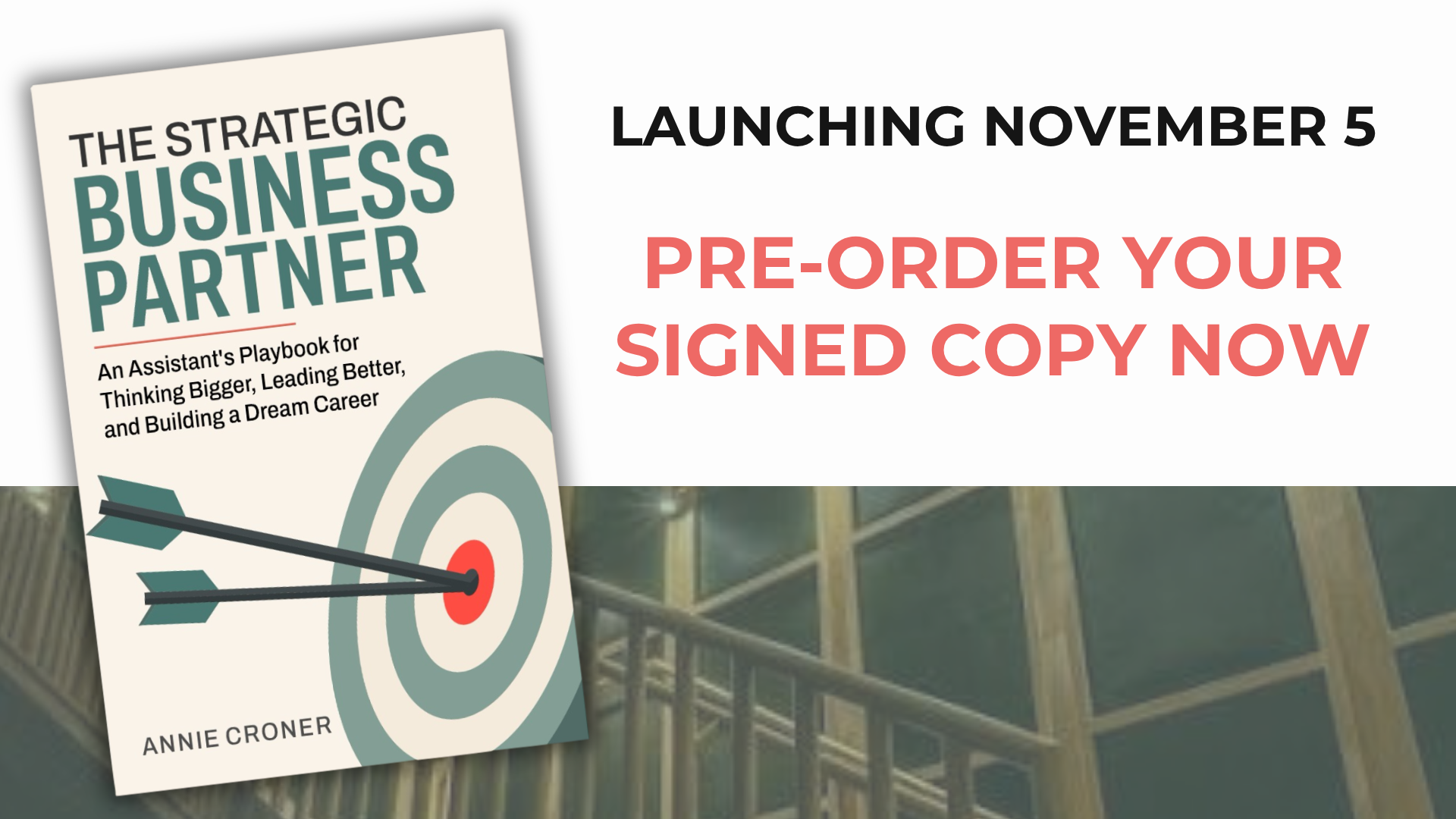
Welcome to the Whole Assistant Podcast, where assistants come to embrace their badassery and discover how to show up more strategically for their careers, their executives, and most importantly, themselves. I'm your coach, Annie Kroner. Join us as we dive into the skills, strategies, and mindset that will help you unleash your full potential. Let's go. Welcome back to the Whole Assistant Podcast. Welcome back to the Life of an Assistant podcast. If you are listening to this episode as it is coming out in real time, it is the date of my book launch for The Strategic Business Partner. I am so excited and proud of myself for putting this out into the world.
Speaker A [00:00:41]:
I have on my vision board for this year to write my first book and publish my first book, and this is a culmination of all that hard work. And I am very excited to get it into the hands of strategic business partners. And today is the last of our series in the Strategic Business Partner series, and I'm gonna be focusing on small shifts that will have a huge impact through the lens of my own personal story. And I know many of you have been listening to the podcast since I first launched it a few years ago, but I did wanna recap kind of my story and how I landed where I am today. And share the details of what happened to me back in the day as a piece of the puzzle. And I do go into this in the book, but this is gonna be a little bit of a different lens. I'm gonna be sharing more streams of thought. I do have a loose outline in front of me, but I'm just gonna be open and I wanna share with you guys my personal story and share the subtle shifts that have really helped me level up as a strategic business partner myself, and then also As I launched my business, what that looked like also.
Speaker A [00:01:50]:
So before I do that though, I just want to share with you guys that the book is now available on Amazon and it is going to be available in the Kindle version for 99 cents until next Thursday, November 12th. So it'll be 99 cents from Thursday, November 5th to Thursday, November 12th. Please be sure to grab it. It is a good deal. Obviously, if you have a Kindle, there's also the paperback version as well. If that is more your jam. So please go to Amazon and I will put a link in the show notes below. And if you are listening internationally, it should be available internationally as well on the Amazon platform or anywhere where you buy books.
Speaker A [00:02:31]:
I intentionally made sure that my publisher posted it across all platforms so that you can purchase wherever you feel is convenient for you. Okay, so now to today's episode. So there are several shifts that changed everything for me. And today I've been really contemplative. I've been really thinking about my story and just steeped in gratitude as I go down this path of launching this book and thinking about how this book has called me to a higher level in terms of how I articulate things. And writing is a very different skill than public speaking, which is also a very different skill than putting a presentation together. It's just Really interesting in how I flex that muscle. And I've also been thinking a lot about how much my life has changed since I started my brand, The Whole Assistant, and how it's taken on a life of its own and how I couldn't have envisioned what it is today without some of these small shifts happening.
Speaker A [00:03:34]:
And had I not taken that initial step, had I not actually taken the risk of starting The Whole Assistant, I don't even know where I would be. It's been such a life-changing journey for me. And the piece that kind of started it all was back in 2012 when I suffered a stroke at the office. So for those of you who are newer to the podcast or who are newer to me and you don't know this story, I'm gonna share it today. I may have only shared the entire story once or twice on the podcast, so this'll be a great refresher for those of you who have heard the story before. Or if you haven't heard the story before, this is may be completely new information, but back in 2012, I was living in my hometown of Twin Falls, Idaho. I'd been back for 4 years. I moved from Boston with my partner at the time because he got a job.
Speaker A [00:04:21]:
And honestly, I never saw myself living in Idaho again. I grew up in Idaho. I was born and raised in Idaho. I went away to college at University of Iowa, moved back to Idaho from Boston, which is where I moved after I graduated college. In Boston is where I met Marianne, and you can go back a few episodes. To the one entitled Everybody Needs a Marianne. It was towards the beginning of this strategic business partner series, so I'm not going to go into too much detail there because I really go into detail in that episode. But I moved back to Twin Falls, Idaho, and I was working 60-plus hour weeks supporting the CEO of an accounting firm.
Speaker A [00:04:59]:
And it was the middle of tax season. It was March 14th, 2012. And that night I had gone to bed and I woke up in the middle of the night with this just awful splitting headache, just terrible headache. And I'll never forget the pain. It radiated from the back of my neck all the way up to the front. I took a couple Advil, went back to bed, got up, went to the office the next day. Around mid-morning, I went to the back of the office to get something to eat. And I'll never forget, like, reflecting with my colleagues earlier that morning that I was just feeling a little bit off, just feeling a little bit wonky, and told them about the headache I had had earlier.
Speaker A [00:05:35]:
And so I'm in the back of the office where the kitchen is, grabbing a bite, and I blacked out for a minute. I knew I needed to make my way back up to the front of the office where my colleagues and executive were. As I made my way to the front of the office, my left arm went rigid. My fist was up near my shoulder. My left leg started dragging behind me. The left side of my face started drooping. I was floating about 6 inches above my head, looking down on the scene. It was an interesting experience.
Speaker A [00:06:04]:
And I had so many words to say, but I couldn't voice any of them. My colleagues began to notice that something was off or wrong, and they called an ambulance immediately. And I'll never forget the look of horror on a few of my colleagues' face. They just looked terrified. And as I was being whisked away and put into the ambulance, and then I got to the hospital, they cut off my dress. It was like one of my favorite dresses. And I'm like, this is an overreaction. What is going on here? This is absolutely bonkers.
Speaker A [00:06:34]:
They put me into the tube. and they found that I had had a stroke. And what had happened the night before was my carotid artery had randomly dissected. They called it a random dissection of the carotid artery. The carotid artery tried to clot and the clot broke loose and went up into my brain, and that's what caused the stroke. And so they ended up life flighting me to Boise, Idaho, which was the nearest capable facility to be able to handle my situation. And in the helicopter, I will never forget, I just had this like wave of peace wash over me. And I knew in that moment that if I died, I was okay with that.
Speaker A [00:07:09]:
I had made my peace with that. But if I was going to live, I knew that everything would be different from then on out. And so I was rushed to the hospital. The doctor that works on me, he was able to suck the clot out doing an angioplasty angiogram using that technology, able to suck the clot out. And I was in the ICU for a week and then in the hospital for 2 weeks total before I was released. And then I actually was readmitted a week later when I started seeing like auras and I was afraid I was having another stroke. And so I called the doctor and they ended up life flighting me again. And then I ended up being stented in that right carotid artery.
Speaker A [00:07:54]:
And the recovery period was something else. I was out of work for 6 weeks. When I went back to the office, I was told I wasn't worth what the company was paying me. I was told that they were gonna withhold my bonus, and I also got demoted. And that was a really interesting experience because up until that point, I had made it my mission to make sure that everybody was taken care of, to please everyone else without actually considering what would fill me up and bring me happiness. And I so believed in people who were older and wiser than me. I so believed in others who have gone before me. And also I had this like identity of being from Western stock, and we don't complain, we don't moan about things, we just pick ourselves up and keep on going.
Speaker A [00:08:40]:
And grit and tenacity were a large part of who I was, or believed I was. But kind of the shadow side with— of that was that I was people pleasing, and I was trying to make everyone else around me happy. And I thought that that would somehow create happiness and fulfillment for me. But that experience forced me to look at how I was living, and changing those patterns has taken a long time. In fact, I'm still unraveling some of those patterns, especially in dating. As I spoke about in an episode ago or two episodes ago about my dating, like it really has revealed pieces of myself that I was unaware of because until we bump up against those things, we don't actually know what we're struggling with. And so the year. year that followed the stroke was really interesting.
Speaker A [00:09:25]:
I was pushed out of my job because it turns out when you have a stroke at the office, people don't know what to do with you when you come back. I was forced to move back in with my parents. My marriage fell apart. I could no longer hold everything else together for everyone else. I had to take care of myself. It was a cosmic reset that I needed in order to be able to actually bring that forward, that I had to prioritize myself. I had to prioritize my own mental health, my own well-being. I got myself into therapy.
Speaker A [00:09:52]:
And so I lost my job, I lost my marriage, moved back in with my all within a year of the stroke. And I also had to relearn how to do basic functions. I had to relearn how to walk and talk. And I'll never forget sitting in front of my microwave, knowing I'd operated it a million times before, and being unsure of what button to push to heat up my lunch, right? So it's really fascinating what happens when you're in that situation and just how the situation can really play with your brain if you let it. And there were several stories that I could have believed about myself long-term, but fortunately I had a great therapist who was really helpful. And then after I moved to Denver, which was like a year and a half later, that was also really helpful. I got into therapy again here in Denver. I ended up meeting my therapist who I still meet with off and on today.
Speaker A [00:10:36]:
I love my therapist. Her name is Kim. Shout out to Kim if you're listening to this podcast episode. And I also have a life coach, so I'm a big fan of getting the support that you need in order to point out blind spots, in order to point out like avenues for your growth that you may have been unaware of before. And so I totally could have believed that I was unworthy and invaluable, or that I was somehow less than post-stroke than I was before. And then a few years later, fast forward, I'm working in private equity, I'm working in VC, I'm working for family offices, I'm working for high net worth people. And I just felt called to share my story. And I also felt called to create a community, and I wasn't sure what that would look like.
Speaker A [00:11:22]:
So, I created a Facebook group and I had an entry question in the Facebook group and I asked, what is one thing you're struggling with? And the majority of people who joined the Facebook group said it was something like, it's hard to keep all the plates spinning, things are falling through the cracks, I don't know how to manage my time effectively. And by that point, I had really fine-tuned how to manage my time. So I created my first course, which was a time management course. And I have to tell you guys that doing that was really a very cool experience because I was able to draw in all my experience and it was a culmination of all of that. And it's really fascinating because it was around that time that my mom bumped into my former boss at the grocery store because this is small town Idaho. And my executive looked at my mom and she's like, Annie's different, isn't she? She's not the same. And my mom was like, oh no, she's doing great. And I actually had to let my executive be wrong about me.
Speaker A [00:12:21]:
My executive probably still believes that I'm incapable or inadequate in some way, but I don't put clout in that anymore. And I have to be honest with you guys, at first I did. For like the first 4 or 5 years after my stroke, I had this need to prove something until that piece healed in me and until I found completeness in my own Enoughness. And so this is why I'm a really big fan of making sure that you're taking action from the place of your own enoughness, because I could have believed something that would have been entirely unhelpful for a very long time post-stroke if I'd allowed myself to. And so my question to you is, where have you accepted someone's assessment as the final word on your potential? Where have you accepted that? I really want you to let that question sink in because what other people think doesn't have to define you, nor do we have to prove anything to anyone. You are complete and enough as a human because you draw breath on this earth, and you are worthy because you draw breath on this earth. Now, of course, if there are skill gaps that you want to fill, that's lovely and wonderful. Go get all the skills that you need in order to do the job that you wanna do, in order to be the person that you wanna be, in order to live the life that you wanna live.
Speaker A [00:13:41]:
But that is the most amazing question I was able to answer for myself is like, how can I let go of someone else's assessment? How can I let go of someone else's judgment of me so I can step more fully into who I am meant to be and what I am meant to bring into this life and into this world? And so really the profound shift that I made for myself were to implement boundaries that would help protect my time and energy, And also to help me to stop people pleasing, to help me to really decide how I wanted to show up for any situation. And boundaries are gonna be very, very integral. They're gonna be a very big part of that. And through that, you will develop this self-trust, really leaning into what you know to be true for yourself and not outsourcing that piece, that self-trust piece to somebody else. Like I did for so long, and also using your voice. Now this one I'm still working on, and I really have this desire moving forward to be fully self-expressed, to not hold back my voice or my opinion, and to say what I need to say in love for sure, and in compassion for others, but in truth for myself. And that is my next level. And as I've kind of peeled back the layers of using my voice and I've stepped more fully into that, I have found such deep self-satisfaction, such deep self-trust.
Speaker A [00:15:05]:
So using your voice and self-trust and all of that, it's kind of like a cycle. It's like this little loop that reinforces one another. As you trust yourself, you use your voice more, and as you use your voice more, you'll trust yourself. It really is taking that first step and what you know to be true for yourself. And so those shifts— boundaries are a big one. You recognize your limits. Don't overcorrect like I did, cuz I totally overcorrected once I figured out what my limits were. Then I'm like, you get a boundary, you get a boundary, you get a boundary.
Speaker A [00:15:35]:
That's also not helpful. It's not a great way of, of setting boundaries. We wanna set them with intention and on purpose and not as knee-jerk reaction. I have become much more intentional and I know and like my reasons why I set the boundaries I set. I think also self-trust and like moving away from the constant need for external validation. And making decisions that support me long-term, even if they don't make sense to anybody else in my life, has been very profound. And allowing myself to be misunderstood in that, which is like so challenging, especially if we want the approval of people in our lives and our family or whatnot, like that could be a real big challenge. And accepting and knowing that they have your best interests at heart and they're speaking in love to you, but you having a different vantage point.
Speaker A [00:16:24]:
and a different sense of self-trust, that can be really jarring, especially because I think all of us wanna be a part of a tribe. We all wanna belong and we all wanna feel accepted. And then using your voice, expressing your opinion, if something doesn't feel good to you, actually sharing that with somebody. And I have to say, like, there is an inner safety that we can all have for sure. And if you're in an environment that isn't supportive of you and you don't feel safe in your environment, that is also something to look at. I think that safety in any environment is very, very important. So if you're currently in an environment where you don't feel safe to raise issues, you don't feel safe to use your voice or speak up, that would be something I would really seriously consider changing. Maybe changing your environment or looking internally.
Speaker A [00:17:12]:
Is this a me issue? Can I use my voice Is there an actual threat to me, to my income, to my relationship with my executive or this company? Or is it just something internal in me that I can shift and create that safety for myself? So it's kind of both and, cuz we don't want to speak up in an environment where we are legitimately unsafe or feel threatened. Maybe there's some other unsafe factors in your work environment. Protect yourself. I'm not saying don't protect yourself, but also like really get clear on whether or not this is a me issue and how can I create safety for myself? And also how can I, through creating safety for myself, put myself into a situation where I will also feel more safe, right? Because obviously post-stroke, when I went back to the office, that wasn't a safe environment. My executive really wasn't in support of me. I kind of had been vilified and othered as this person who now had this mental injury, this brain injury. She made up her mind about me and I couldn't change that. And she probably still holds those opinions today and I can't change those opinions.
Speaker A [00:18:18]:
So really my time at that office was done because I needed to be in an environment where people actually believed that I was capable of kicking butt and taking numbers. And obviously I was because obviously I went on to support high net worth people in the venture capital and family office spaces. I was the right-hand man, was a strategic business partner. I've now written a book all about strategic partnerships, so That's not true at all. And even through that process, I knew deep down it wasn't, but I would be lying if I said my confidence wasn't shaken for a little while. Okay, so for each shift, follow the same simple rhythm: what I used to do, what I tried, and what changed. What I used to do, what I tried, and what changed. And then really lean into that new identity.
Speaker A [00:19:08]:
You can practice a different response before it feels natural. And so I don't want us to take action after we feel confident in taking it. We actually gain the confidence through taking the action. And so that's just something to bring your awareness to. Also, changing how I work created room for something much, much bigger. And so the internal shifts of practical changes in my work Moving from being everyone's solution to helping everyone create solutions, building systems, batching work, reducing distractions, protecting focus. All of those things really helped, but really the internal shifts, the internal shifts around worthiness, the internal shifts around that self-trust, self-confidence piece, the internal shifts around using my voice. And look, I am still in process.
Speaker A [00:19:57]:
I have not nailed this by any stretch of the imagination, but I am several years down the path in my journey. So actually asking yourself, like, what shifts do I need to make internally? What shifts can I make externally? How can the internal shifts drive the external shifts? Will be really, really powerful for you as well. And I was drawn to coaching because I hired a coach to help me with these things. And so if you would like help with this, please consider joining Empowered Seat. Empowered Seat is where it's at. We come together I coach. I also pull other people into the conversation as well. Growth includes revisiting your choices as your life changes and also revisiting your values as your life changes.
Speaker A [00:20:41]:
So I think that's the takeaway, is that really making those subtle shifts and taking the step to make the subtle shifts is where the magic happens. I actually built my business during a time in my life that was a little crazy busy. Like, I was working full-time as an executive assistant to managing director of a VC fund. I was also having babies at that time. I had my 2 boys, and I would wake up at 5 AM to write, and it didn't feel like work to me. There were days that it was challenging, but I knew deep down that I felt called to share my story of the stroke, to share these shifts that I had made that were really impactful for me, to share how I had Gone from being told that I wasn't worth what the company was paying me and being demoted to starting my own company, coaching and training executive assistants. There's real power in that. And none of it would've happened had I not had the self-trust to pick myself up, had I not had the self-belief to take the first step.
Speaker A [00:21:43]:
And my business looks completely different than the day I started it. I had no idea I'd pursue coaching. At that point, I'd never been coached. The journey I have gone down all started because of one small step. So my challenge to you is, what is one small step that you need to make, and how can you take a small step towards that? How can you take action on that, even if it's itty-bitty? That is the power move for this week's episode. I hope you found this episode helpful. Be intentional, be whole. That is all.
Speaker A [00:22:14]:
For now. If today's episode gave you language clarity or just a quiet, oh, it's not just me, I am so thrilled you're here. If this podcast has been helpful for you, the easiest way you can support the show is by taking 30 seconds to rate and review it on Apple Podcasts or Spotify. This helps more assistants find this work. And if you're ready for ongoing support, guidance, community, and growth that actually fits into your life, Empowered Seat is where we continue this work together. It's affordable, flexible, and designed for assistants who are done white-knuckling their careers in isolation. You can learn more and join at wholeassistant.com/empoweredseat or click the link in the show notes below. And until next time, go embrace your badassery.