Annie Croner [00:00:01]:
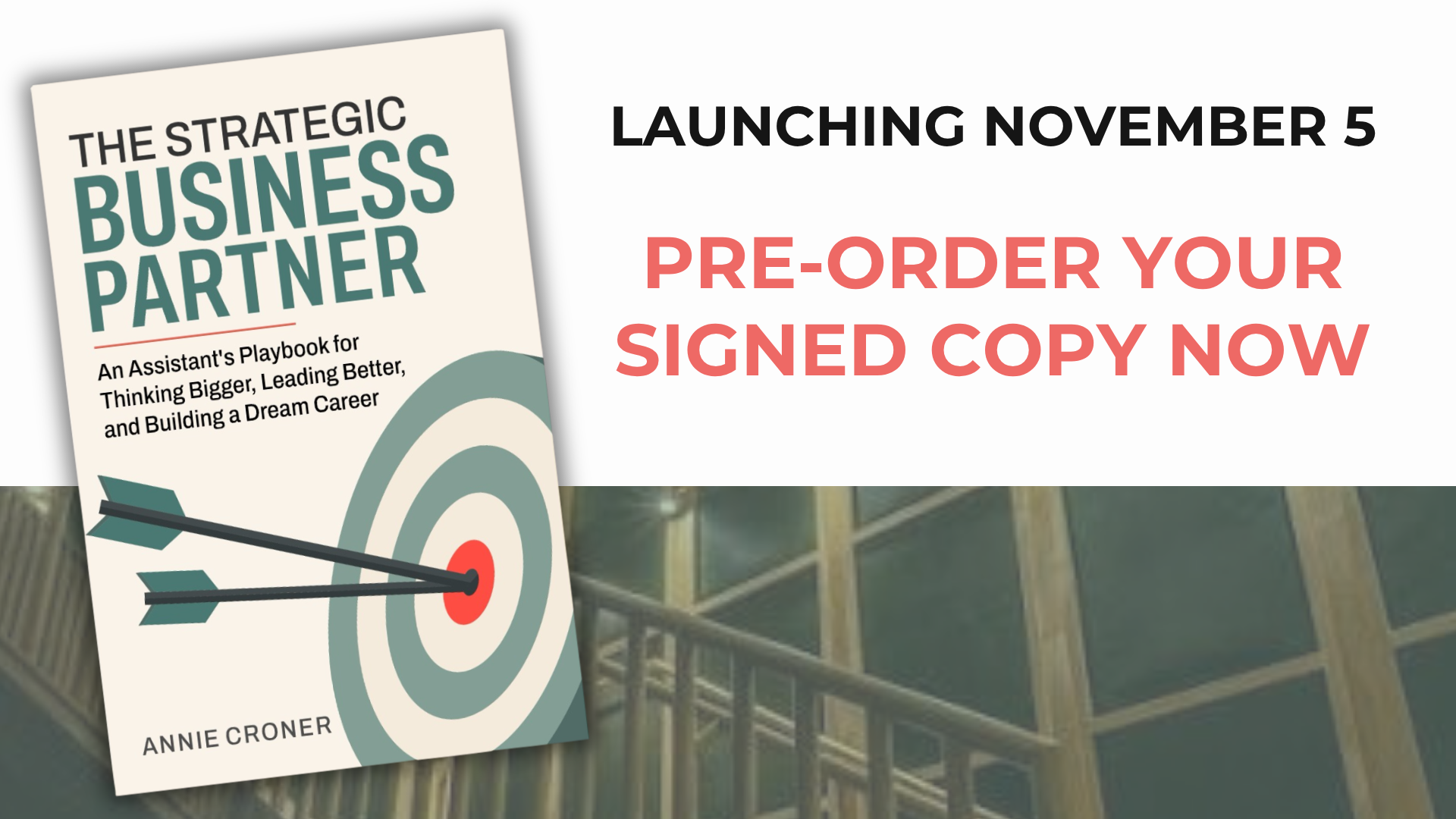
Welcome to the Whole Assistant Podcast, where assistants come to embrace their badassery and discover how to show up more strategically for their careers, their executives, and most importantly, themselves. I'm your coach, Annie Kroner. Join us as we dive into the skills, strategies, and mindset that will help you unleash your full potential. Let's go. Welcome back to the Whole Assistant Podcast. This is week 4 of our Strategic Partner series centered around my book, The Strategic Business Partner. And today we are talking all about what actually builds confidence. And if you're interested in getting your hands on the book, you can go to wholeassistant.com/book-bundles.
Annie Croner [00:00:49]:
I'll link to it below in the show notes. And if you are local to Denver, please join us on November 5th. That's the day of the book launch at the Clayton Club in Cherry Creek from 5 to 8. I'll be hosting a book launch party. You can go to wholeassistant.com/rsvp to RSVP for that. It's totally free. There will be drinks, there'll be hors d'oeuvres, there'll be lots of amazing executive business partners to talk to, to network with, all the things. It's gonna be a good time.
Annie Croner [00:01:20]:
So please join us. So I love this topic of confidence and I love helping people develop their confidence. And I'm a firm believer that confidence is a byproduct of really going deep into self-trust and trusting yourself to pick yourself up if you fall down, trusting yourself to have your own back, trusting yourself to show up with grace. And compassion and all of those things. And the first thing that actually builds confidence is allowing challenging emotion. And I know that many of us may think that sounds weird, but oftentimes we don't wanna take a risk because of how we'll feel if we fail. We don't want to put ourselves out there because it feels really vulnerable, and we have not yet built the capacity. Mm-hmm.
Annie Croner [00:02:12]:
To hold our emotions and to know that we're going to show up with grace for ourselves in the event that things don't go according to plan, right? And so the risk is can be challenging, especially for us as executive assistants. A lot of us can tend to be risk averse. But here's the deal: by increasing your capacity to experience emotion, the negative with the positive, it's like a balloon. So you work on this ability to fall down and get back up and fall down to get back up. And then after a while, you develop the confidence that regardless of what happens, you're going to get back up. And so increased capacity also means increased mental toughness, increased resilience. With mental toughness and resilience comes confidence. It's like a byproduct of developing those skills.
Annie Croner [00:03:01]:
And those are actual skills that we can actually develop over time. By increasing our capacity and putting ourselves in situations where we may wanna take a risk, we may want to ask for a raise, may, we may want to ask for promotion, we may want to move on from our role and seek another role or seek a different type of role. I've coached so many support professionals out of the support profession, it's not funny. But here's the deal. I'm a firm believer that every path is unique and every path is different, and we all have unique gifting and how we actually tap into that gifting and how we actually create confidence in that gifting. Is by creating the capacity to be with ourselves in any emotional state. And I understand that this can be super intense. This year, I have really been increasing my capacity to deal with discomfort, increasing my capacity to also experience more joy, and to really unravel my kind of programming around dating and that sort of thing.
Annie Croner [00:04:04]:
I am divorced now for a year and a half almost, and I have decided to get back into dating as a way to discover more about myself. And in the past, I've dated to find a partner. And this time I've decided that if I find somebody that I want to be with, that's great. But I'm really dating to discover what I like, what I don't like, to discover more about myself, to discover what feels good in my body. In terms of people's presence and in terms of what makes me feel safe and what makes me feel empowered and what makes me feel good and like I can be myself around somebody and what does that look like. And I have had to confront a lot of challenging emotions, including embarrassment, shame, vulnerability, the discomfort of being honest with myself and being honest with other people. Whereas in the past, I may have tried to shrink to fit, to be with a certain person, or to be chosen even, right? And now I'm doing the choosing, and that feels really empowering, but it's not been without its discomfort for sure. But as I create the capacity to hold that discomfort, to hold all of those challenging emotions, I'm also increasing my capacity for joy, for peace, for self-love, for self-trust, for confidence in knowing moving forward what I like and don't like and carrying that forward in a really cool, powerful way and stepping confidently into my knowing more about myself in this realm that I have been out of practice with for years.
Annie Croner [00:05:44]:
And even prior to that, was viewing dating from a different vantage point and through a different lens. So I don't I don't think I grew as much through my last dating experiences as I have this one because I've been very intentional about really paying attention to what I like and don't like and using my voice more and being more honest. And you're going to see all of that as recurring themes throughout this episode when it comes to what actually builds confidence. So if you actually want to build confidence, we cannot run away from those challenging emotions. We cannot buffer and By buffer, I mean distract ourselves, right? We cannot turn to Netflix or to food or to sweets or to alcohol or whatever it is we turn to whenever we're experiencing emotional discomfort. If you can actually allow yourself to sit in that discomfort and to process through it and to allow the emotion to come up, that is what creates the capacity. That is what creates the resourcefulness and the resilience within you to then create the confidence that you are going to need, the self-confidence and the self-trust in order to move forward and in order to really have your own back in any situation. So that is the first step, or the first thing that actually builds confidence is allowing challenging emotions.
Annie Croner [00:07:02]:
The second thing that builds confidence is risk-taking or failure tolerance. And this one is a big one for us because as executive assistants, we like to look like we have it all together. We don't like to fail. We don't like to make mistakes. We don't like to take risks. We'd rather play it safe because we don't wanna look foolish, because we don't wanna look silly, because we don't wanna look stupid. And look, I get that. And I also understand the strong desire to wanna be seen as a competent person.
Annie Croner [00:07:33]:
But here's the thing. You don't make any of the shots that you don't shoot. So what ends up happening is, because we want to play it safe, is we don't shoot our shot, which means that we're actually failing by default that way. If we don't shoot our shot, we'll never know what we're capable of. We'll never know what we actually have the capacity to create in our lives, and we won't actually build that confidence piece because we're going to be shrinking back from a challenge. We're going to be shrinking back from a risk. Now look, I am all about calculated risk too. I'm not saying to go out and take a risk that feels misaligned for you or that feels like a risk that you don't want to take.
Annie Croner [00:08:16]:
But if you're taking aligned action, if you're taking an aligned risk, chances are you will surprise yourself. And even if you don't surprise yourself, you will develop that resilience piece and that inner resourcefulness that leads to increased confidence. So back in the day when I was first starting out as a speaker, I spoke at this conference and I share this story in my book as well. I spoke at this conference and I was asked to speak on a topic that I had trained on in the past, but, uh, only online and only through a very specific lens. And it was around a tool that I had used. It was a technical training and I had failed to take into account the variety of technical savvy in the room and I had people walking out of the space. The training session was a disaster. I was speaking, it was my first time speaking at a conference.
Annie Croner [00:09:06]:
I crushed it in a couple of other sessions, but this particular session was just a disaster, right? But here's the deal. I trusted myself at that point to pick myself up and keep on going. Did I experience embarrassment? Yes. Did I experience shame? Absolutely. Did I experience the feeling of wanting to crawl under my desk and melt into the floor? 100%. I absolutely experienced all of those things. But I also knew that by picking myself up and keeping on going, that would help me to become a better speaker in the future. And I've gone on to speak on many stages, large stages.
Annie Croner [00:09:44]:
I do trainings in corporate all the time. And I have to tell you guys that it's been very profound for me to actually step out and take the risk. And oftentimes I surprise myself too. That's another thing. We think that we're going to fail. Or we go to the worst case scenario in our head, but taking the risk and actually surprising yourself is also something that happens and it happens regularly. And even through that whole thing of speaking on stages and not being sure of myself and trying something, I learned a lot about myself. I learned that I am not a technical trainer.
Annie Croner [00:10:18]:
I have no desire to teach about a tool unless it's in the context of my membership or one of my courses, and it's for a very specific use case. I have no desire to train around a tool. It's just not what I wanna do. I'd rather train on developing a strategic mindset, productivity tips and strategies, how to streamline workflows and that sort of thing. I'm much more proficient in those things. I'm much more proficient on boundary setting and those types of concepts, the concepts I cover in my book, than I'm ever gonna be around technical training. But how would I have known that? Unless I actually gave it a shot, unless I actually put myself out there and tried it, right? So this is all a self-discovery thing. And then knowing that now, I'm like, okay, so I'm asked to, if I'm ever asked to train on technical things again, that's just a hard pass for me because it's out of alignment.
Annie Croner [00:11:12]:
So there again, we wanna take risks that feel in alignment with us, that feel like we're riding that edge of discomfort. And if we fail, picking yourself back up again and keep moving forward and keep progressing and keep learning and keep growing, that is how we actually build confidence. Confidence is built through action, not before it. And so often we want to feel confident before we take the action, but actually it's the action that builds the confidence. So it's just something good to bring awareness to. And I think in We're taught to never fail. We're like the A and B students get all the accolades, you know, all that. But failure actually has a lot to teach us too.
Annie Croner [00:11:56]:
Okay? And so shooting your shot, asking for the raise, asking for the promotion, asking to only support one executive instead of 5, whatever it is that you want to ask for in your role, whatever it is that you wanna put yourself out there for. Take your shot because at the very least you will walk away with a data point and then you can make an informed decision moving forward. The third and final thing that actually builds confidence and is very closely linked to this last thing that I just talked about with risk is using your voice. Every time you speak up, you reinforce the idea that your perspective has value. And I am a firm believer of embracing being the weirdo in any room you're in. And I have coached so many assistants around this where they feel out of place in an ELT meeting, where they feel out of place in a board meeting. And, you know, they may not understand the lingo, they may not understand all of the verbiage and what's going on, but they see red flags and they're like, why is nobody bringing this up? Because this is a big deal. Well, you're the one to be able to bring it up.
Annie Croner [00:13:05]:
You are the boots on the ground to their vision. You're in this room full of visionaries, and our brains operate differently, and that is a gift. So embracing your weird, speaking up, using your voice, offering a different perspective when it is required. Because here's the other piece of that. Everyone is shiny and clean and nobody complains to the executives, but they sure as heck don't mind complaining to the executive assistant. So you do have a different perspective. You're sitting there thinking about how any decision made in that room is going to trickle down and the effects it's going to have on your organization and the culture. And your voice is so needed and so necessary in those spaces.
Annie Croner [00:13:47]:
And every time you use your voice, you are going to reinforce that your perspective there again is valuable. And that is going to be tremendously helpful for you in building that confidence piece, in understanding how you fit into the larger picture, and in really offering tremendous amounts of value and strategic partnership to your executive. So this week's power move is to use your voice, shoot your shot, take the risk, and allow whatever comes up in terms of emotions— allow yourself to actually experience those emotions as an exercise in creating capacity for yourself to be with yourself, to be with your emotions, and just recognize also that with that capacity to experience challenging emotion also comes increased capacity to experience joy, to experience resilience, to experience resourcefulness, to experience this feeling of empowerment, right? So that is what I have for you guys today. I hope you found this episode helpful. Please join us again on November 5th. If you're local to Denver, come down to the Clayton Club. Click the link below to RSVP, and I will see you in next week's episode. If today's episode gave you language clarity or just a quiet, oh, it's not just me, I am so thrilled you're here.
Annie Croner [00:15:11]:
If this podcast has been helpful for you, the easiest way you can support the show is by taking 30 seconds to rate and review it on Apple Podcasts or Spotify. This helps more assistants find this work. And if you're ready for ongoing support, guidance, community, and growth that actually fits into your life, Empowered Seat is where we continue this work together. It's affordable, flexible, and designed for assistants who are done white-knuckling their careers in isolation. You can learn more and join at wholeassistant.com/empoweredseat or click the link in the show notes below. And until next time, go embrace your badassery. Hey.