Annie Croner [00:00:01]:
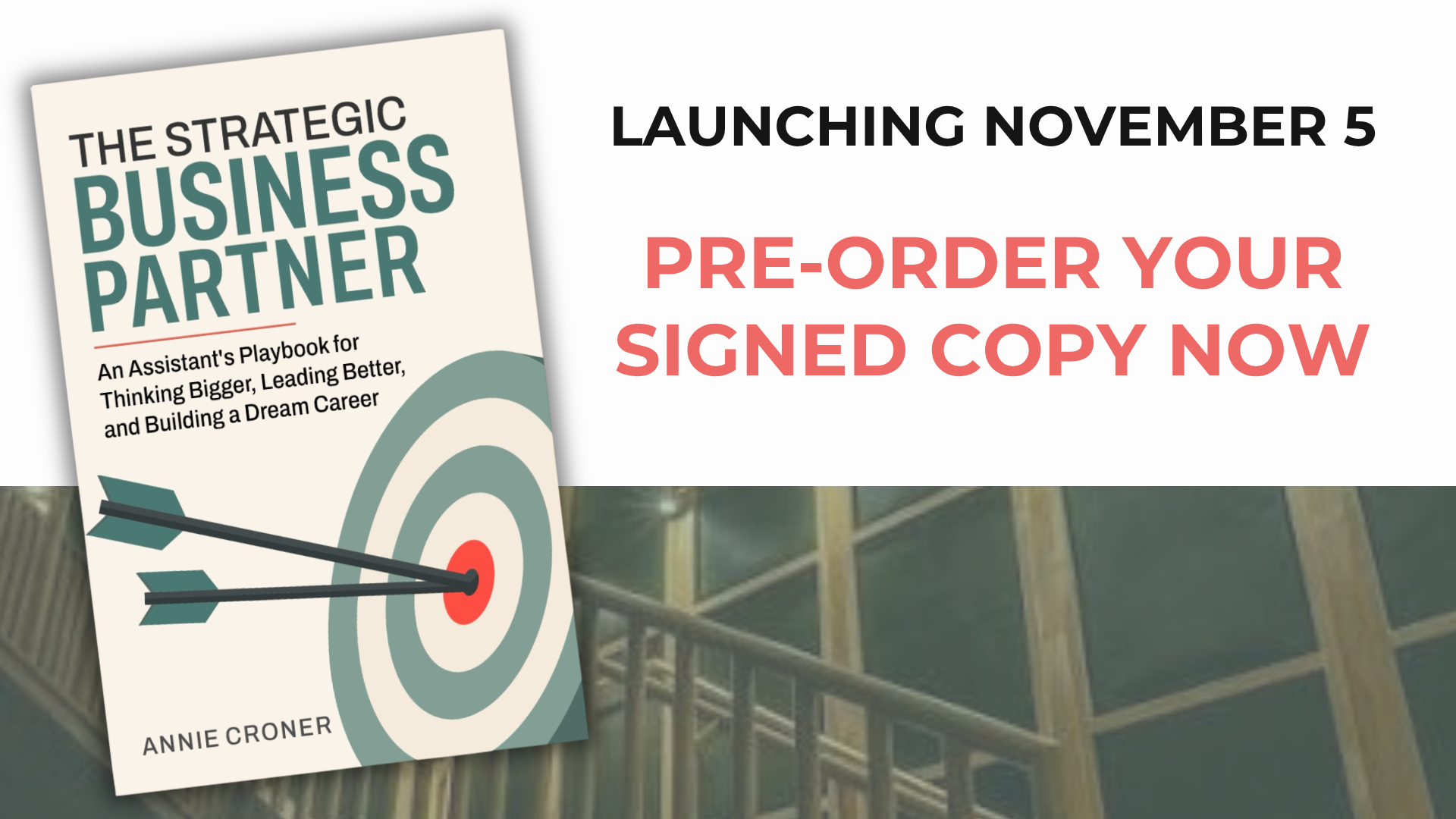
Welcome to the Whole Assistant Podcast, where assistants come to embrace their badassery and discover how to show up more strategically for their careers, their executives, and most importantly, themselves. I'm your coach, Annie Kroner. Join us as we dive into the skills, strategies, and mindset that will help you unleash your full potential. Let's go. Welcome back to the Whole Assistant Podcast. As of the date of this release of this podcast, we are 3 weeks out from the launch of my book, The Strategic Business Partner. I am so excited to get this into everybody's hands. This is literally my thought leadership in the space.
Annie Croner [00:00:42]:
It's a culmination of thousands of hours of coaching. It is also my own personal experience in this book, and I am very excited to share it all with you. If you want to preorder a signed copy, you can go to wholeassistant.com/book-bundles or click the link in the show notes below to grab your signed copy of this book. There are, there's very limited availability for signed copies. I ordered a bunch of books from a local printer here in Denver. I'm going to be signing them personally. I'm going to be mailing them out the week of November 9th, right after the book launches. So if you wanna get your hands on a signed copy, Please do.
Annie Croner [00:01:19]:
It is available to you in the link below. And also, if you're a local to Denver, please join us on November 5th at the Clayton Club in Cherry Creek for the in-person launch party from 5 to 8. You can go to wholeassistant.com/rsvp in order to claim your spot there. There's very limited availability. I think there are only like 75 that we can take for the live launch party, but it is totally free. Please join us, especially if you're a local to Denver. It's gonna be a good time. Dress as business, or if you want to dress up, cocktail attire will be allowed.
Annie Croner [00:01:53]:
I'm gonna be wearing a cocktail dress myself. And then also that same day, November 5th, the day of the book launch, I'll be hosting an in-person training session at the Clayton Club where we're gonna dive into the strategic business partner from 9 to 3. I'm gonna be breaking down concepts. We're gonna be doing deep dives. It's gonna be a discussion. This is a very small group of people. There's only a limited number of seats available because I wanted to keep this day-of event intimate. And you will also get a personalized signed copy where I'm going to mention your name as I'm signing them.
Annie Croner [00:02:27]:
And we're just gonna do a deep dive and it's gonna be a time of bonding and connection and really leveling up in the best way. So if you're interested in that, there's also a link below with more details with regard to the in-person training that day. And now it's time to get going. This is part 3 of the Strategic Business Partner series, and I'm gonna share today the power of tiny systems. And the reason I wanna do this is because oftentimes we just adapt to the headaches and we don't actually solve for them. There's something that's not quite going right in your workflow. There's something that's not going quite going right. In your partnership with your executive, something feels a little bit off, and oftentimes we are going at such a clip or going so fast that we fail to recognize what that is or we fail to solve for that.
Annie Croner [00:03:22]:
And it is really important that we do solve for it because this is going to relieve a headache for you or for your executive. So here's the thing: when I talk about headaches, what I mean is either a headache for you. So One way that we can solve for headaches for ourselves is by starting earlier. I'm going to give the example of getting my boys out the door in the morning. I've got 4 and 6-year-old boys. It's a lot to get them out the door in the morning. I would get super stressed when it would come time to leave to take them to school because I'm trying to start my day and inevitably one of them would have a meltdown. And how I've decided to solve for this is by really sinking into presence and to start the process earlier, 'cause when we start the process earlier, it gives us more time, more lead time, more time to get into the car, more time to enjoy each other, more time to not disconnect.
Annie Croner [00:04:14]:
And that's what I was doing when I was trying to rush them out the door is I was disconnecting from them and trying to control the situation instead of engaging with them, instead of connecting with them, instead of bringing along for the process, and instead of slowing that process down. Yes. And here's what I've found over the years is that love is slow, right? So if I'm rushing my kids out the door, Oftentimes I'm not acting from a place of love for them. And it's totally okay. It's totally natural. It's totally normal to do this, but I just wanted to feel more love and experience more love in my mornings and relieve that 10 minutes of stress of getting everybody out in the door and into the car. 'Cause that 10 minutes of stress was just really weighing on me and it wasn't good for them either, nor was it good for our relationship. So I just started earlier.
Annie Croner [00:05:00]:
I start the process of getting my boys out the door 10 minutes earlier, Gives us plenty of time to still have banter, to still have fun most mornings. And here's the deal, we can apply this to our work lives as well. Things like reservations. So I was also a personal assistant in my last role in addition to being an executive assistant. And every year there for a little while, my executive would come to me a week before Valentine's Day and be like, Annie, I need a reservation. And I would be at a loss cuz there were no more reservations at the restaurants they wanted to eat at that were available. Mm-hmm. So then I'd be spinning my wheels trying to do that, and it would take me like a couple hours to an entire afternoon to track down a good, decent reservation for them.
Annie Croner [00:05:43]:
So I put in my workflow to start that process earlier. So on January 15th, I'd reach out to him. I'd be like, hey, what do you wanna do for Valentine's Day this year? He'd give me the plan and then I could go ahead and make the reservation. It would take me 10 minutes and it was done instead of hours. And so I think starting earlier. Mm-hmm. Also saves us time and energy. Another area that we can start earlier in is with board meetings.
Annie Croner [00:06:08]:
So if you schedule your company's board meetings, if you're the executive assistant to the CEO or the board liaison for your company, start to schedule those board meetings now. Beginning of Q4, end of Q3 the year before, go ahead and book 2027's board meetings now as opposed to having to spin your wheels. Later and try and herd cats and try and get everybody's calendars and schedules to align. Announce those board meeting dates now for 2027. And also, what can you anticipate, right? So my executive, I could see the writing on the wall that he was gonna wanna have charter services for flying private eventually. There had been a bit of talk about it, a bit of ideation, and I could just see the writing was on the wall. So I started gathering vendor information. Started creating a spreadsheet of pluses and minuses with various different companies.
Annie Croner [00:07:03]:
And that way, when he actually came to me and asked about charter services, I already had a spreadsheet. I could make my recommendation to him and he could move forward with the decision. So what can you anticipate and how can you create a tiny system in order to solve for that? Also, when it comes to reducing headaches by creating tiny systems, also consider What is a headache for your executive? And by that I mean, what does your executive notice? Right? So I was meeting with this client the other day and this person was telling me about their executive and how their executive has like multiple inboxes and how she tries to stay on top of the inboxes and she isn't quite sure how. And then something fell through the cracks. And what I encouraged my client to do was to create a protocol for herself, to create a checklist every single day and to put it into her calendar to go in and check email first thing in the morning. Sometime around noon, midday, and then before you close out at the end of the day, just to ensure nothing has shifted or moved with calendar or whatnot. And that's the only way that we're going to stay on top of things is if we actually make a plan for them, is if we actually create a little tiny system for. And for this person, I encourage them to really dive into what their executive is going to notice and make sure.
Annie Croner [00:08:24]:
That they weren't putting the smaller things aside because of the larger projects at hand, because their executive notices the small things. And I'll also say I've had support in the past who's checked my inbox as well, and I would notice when my person hadn't been in my inbox first thing in the morning, and then I would begin to wonder what else had fallen through the cracks because we had this understanding that this person was gonna check my inbox a few times a day, right? So we definitely wanna take care of those things that people are gonna notice first, especially your executive. And I like to refer to this in my book, I refer to this in my book as boring magic, creating boring magic for yourself. So creating those systems that will serve and support you now into the future, things like automation, things like your task tracking system, things like a system for managing your inbox, things like a system for managing your executive's inbox. These things are super simple, but they actually have to be implemented in order to be effective. And really when you think about it, it's that type of consistency that creates trust, which is why I call it boring magic because oftentimes another larger project will come up. And then the simple things, the things that people, that your executive notices gets put on the back burner so that you can execute on the larger project. We need to be mindful of the fact that we need to be in the details and that we need to be really aware of what our executive is gonna notice first.
Annie Croner [00:09:48]:
And so taking the 10 minutes to check the inboxes, taking the 10 minutes to check the calendars, making sure that your executive has what they need for meetings and such, that is gonna go a long way in you showing up consistently. And also in that, you are also creating trust with your executive. So your executive will know, oh, I know that's not gonna— going to drop this thing because they are so consistent in checking. So really pay attention. What is it that your executive maybe doesn't trust you to do? How can you show up more consistently? How can you create that boring magic for yourself? And what tiny system can you implement so that those small things aren't falling through the cracks? So I had a morning block that I would put in my calendar of things I would check consistently for my executive. I had a noon block of things I would check for my executive, and then I had a closing out of my end of the day block that I would check for my executive. Consistently. And here's the deal.
Annie Croner [00:10:48]:
Oftentimes we start out strong and then it falls by the wayside as larger projects come up. No, we actually have to create the consistency piece and solve for that with the tiny system. So the real challenge will be if you put that in your calendar, not to override it because it's in your calendar every day. We wanna make sure that we are being consistent And then other tiny systems slash boring magic ideas are to create templates. Templates for meetings, templates for one-on-ones for your executives, email templates. I had an end of the week email that I sent my executive with everything that I accomplished for them. Calendar invites. So board meeting calendar invites, ELT meeting calendar invites.
Annie Croner [00:11:32]:
How can you templatize those things to streamline your workflows and to create boring magic for yourself that feels like maybe a small lift in the moment, but over time compounds into large amounts of time being given back to you and large amounts of mental energy being given back to you as well. Another thing that we could do is create checklists. And there again, starting earlier with everything. So looking ahead, anticipating, looking up for a minute and being like, okay, what is gonna come down the pike? How can I start this earlier so that I can get a jump on things and execute now as opposed to like trying to make sense of the chaos later. So your power move for this week is to pick one pain point and create a system that solves it. Just one. And so I really want you to think about something that will help you show up more consistently for your executives, something that will help you show up more consistently for yourself, something that will streamline everything for you and reduce the amount of work later on. How can you solve for that by implementing a system or checklist, Something along those lines now.
Annie Croner [00:12:38]:
So that is what I have for you guys today. I hope you found this episode helpful. Be intentional, be whole. That is all for now. If today's episode gave you language clarity or just a quiet, oh, it's not just me, I am so thrilled you're here. If this podcast has been helpful for you, the easiest way you can support the show is by taking 30 seconds to rate and review it on Apple Podcasts or Spotify. This helps more assistants find this work. And if you're ready for ongoing support, guidance, community, and growth that actually fits into your life, Empowered Seat is where we continue this work together.
Annie Croner [00:13:14]:
It's affordable, flexible, and designed for assistants who are done white-knuckling their careers in isolation. You can learn more and join at wholeassistant.com/empoweredseat or click the link in the show notes below. And until next time, go embrace your badassery.